𐐔𐐯
Latter-day Stats
  • Home
  • Channels
  • Studies
  • Data Explorer

Shelves

  • Use with AI
  • Contact
  • Donate

Samuel Baird projects

  • Latter-day Stats
  • Deseret Wiki
  • Urim
  • Pulpitcontributor
  • Deseret MCP
  • Peepstone
  • Omni
  • Sacred Sites Visited
  • My Reading
  • Collection
All projects →
  • About Latter-day Stats
  • samuelbaird.com

𐐢𐐰𐐻𐐲𐑉-𐐼𐐩 Stats

Latter-day Stats A Samuel Baird project
Sign in
Latter-day Stats

Statistics, research, and creator data on the Latter-day Saint community. Not affiliated with The Church of Jesus Christ of Latter-day Saints.

A project by Samuel Baird.

ChannelsStudiesData ExplorerUse with AIAboutFAQHall of ShameContactDonate
TermsPrivacyCopyrightAccessibility

Latter-day Stats

𐐢𐐰𐐻𐐲𐑉-𐐼𐐩 Stats

Statistics, research and creator data on the Latter-day Saint community. Made by Samuel Baird. Free, independent and ad-free.

samuelbaird.com · All projects · About Latter-day Stats

Also by Samuel Baird: Deseret Wiki · Urim · Pulpit · Deseret MCP · Peepstone · Omni

© 2026 Samuel Baird. Set in IM Fell English, Libre Baskerville, Cinzel & Noto Sans Deseret, after the Deseret Wiki.

Data Explorer

Religious Landscape Study

Pew Research Center · NORC at the University of Chicago

Pew Research Center's third Religious Landscape Study, after 2007 and 2014. 36,908 U.S. adults answered between July 2023 and March 2024 — enough for reliable state-level estimates, and enough to say something about small groups that national polls of 1,000 people can only round off. Latter-day Saints are one of those groups. The study's other contribution is its taxonomy: a branching set of questions about religious identity, back-coded into 298 denominations, which collapse into families of denominations, which collapse into 16 religious traditions.

How we use it

The optional demographic questions in this site's quizzes are Pew's, taken from this study's questionnaire and worded the same way — religion, birth cohort, gender, race, Hispanic origin, education, marital status, and state. The religion list is Pew's own taxonomy in full, down to the denominational family, including the Protestant, non-Christian, and religiously unaffiliated subcategories. Answers given here can therefore be read against a national sample without a recoding step in between.

Graphics

10 graphics

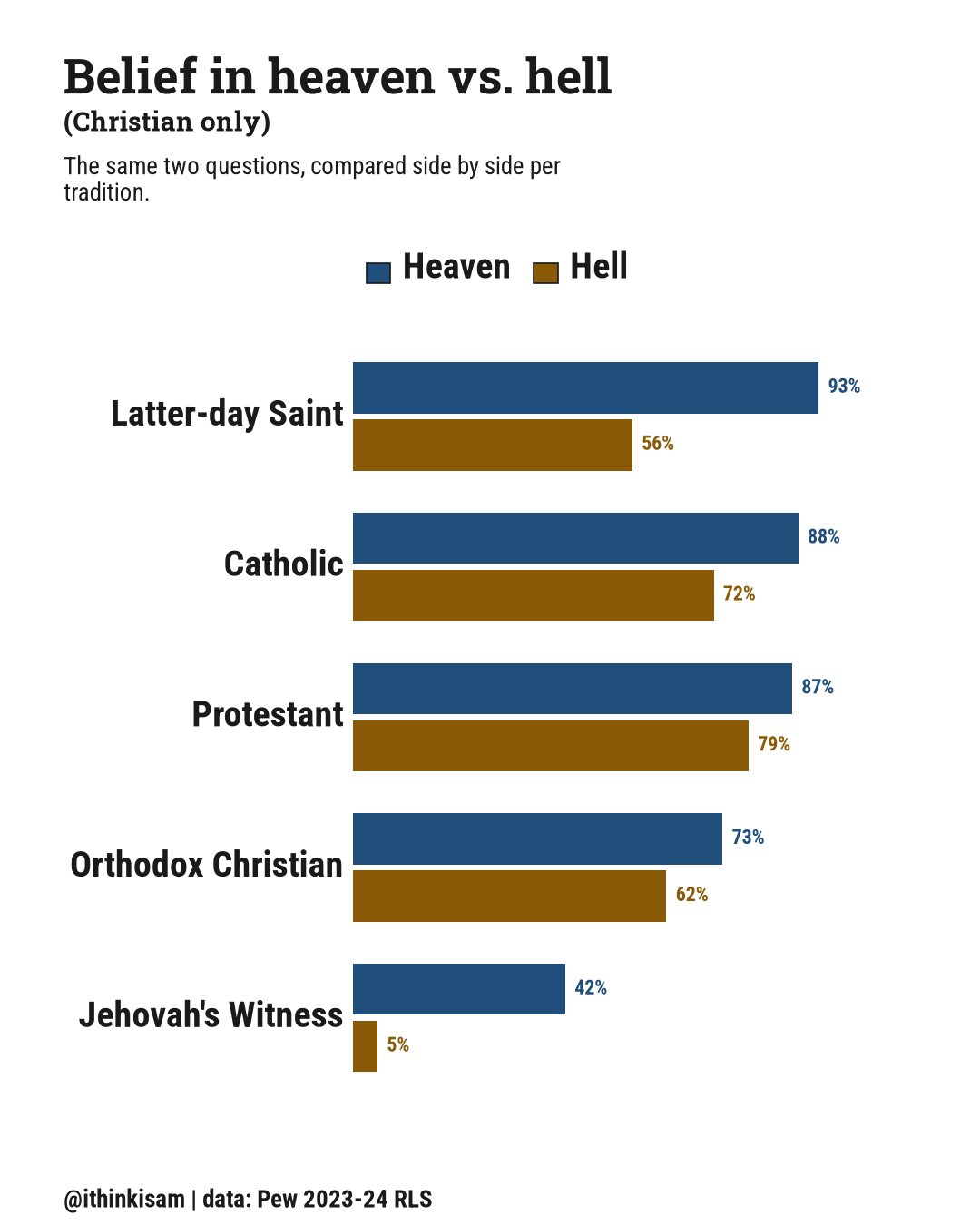
Paired bar chart, belief in heaven vs. hell, Christian traditions and the unaffiliated: Latter-day Saint heaven 93%, hell 56%, Catholic heaven 88%, hell 72%, Protestant heaven 87%, hell 79%, Orthodox Christian heaven 73%, hell 62%, Jehovah's Witness heaven 42%, hell 5%, Religiously unaffiliated heaven 35%, hell 25%.
View all graphics

Cite it as

Pew Research Center. 2025. “2023-24 Religious Landscape Study (RLS) Dataset.” doi: 10.58094/3kwb-bf52.

doi.org/10.58094/3kwb-bf52Download the dataset

Methodology

  • 36,908 U.S. adults, interviewed July 17, 2023 – March 4, 2024, in English and Spanish.
  • A geographically stratified address-based sample; 205,100 addresses were invited.
  • Respondents chose their mode: 25,250 answered online, 10,733 by mail, 925 by phone.
  • The AAPOR RR3 response rate was 20%.
  • Weights are raked to American Community Survey and CPS benchmarks.
  • National margin of sampling error: ±0.8 percentage points at 95% confidence, after accounting for the sample design and the loss of precision from weighting. Subgroups are wider — ±1.7 points for historically Black Protestants, ±8.7 for Hindus.
  • The public-use file withholds sensitive variables, geography among them; a restricted-use file is to reach ICPSR under a data use agreement.
  • Not directly comparable with the 2007 and 2014 waves without care: those were random-digit-dial telephone surveys, this one is mostly online and paper. Pew ran a 1,519-respondent telephone bridge study to measure the mode difference — read Appendix A of the accompanying report before comparing across waves.
www.pewresearch.org/religious-landscape-study/